



Practical harvest, ensiling and feedout steps that protect dry matter, reduce spoilage risk and help keep rations consistent.
Controlling the cost of production is crucial for dairy and beef producers, especially when feed costs and market returns are volatile. One area you can influence directly is the quality of the corn silage you put in the bunker. Because silage can make up a large share of the ration (often up to 50%), improvements in quality and consistency can translate into better intakes, steadier performance and less waste. When corn is grown under drought or other stressful conditions, silage quality can suffer—so careful harvest decisions, good ensiling practice and disciplined feedout management become even more important.
Use the checklist below to get more value from every tonne of corn silage—at harvest, during storage and at feedout.
- Harvest at the optimal maturity to balance yield with feed value. As a rule of thumb, aim for a whole‑plant dry matter that supports good packing and fermentation while maximising starch without sacrificing fibre digestibility.
- If fungal contamination is visible in the field (or even suspected), take steps to limit spoilage and mycotoxin risk in the bunker. Where appropriate, consider a proven inoculant designed to help inhibit yeasts and moulds through ensiling and feedout (e.g., MAGNIVA Platinum 1).
- Cut at an appropriate height (e.g., >20 cm) to reduce soil carryover and help limit contaminants such as clostridia, butyric bacteria and fungal spores.
- Make sure kernels are adequately cracked to improve starch and energy availability. As dry matter (DM) rises, grain processing becomes even more important—aim for no more than 3–4 whole or half-broken kernels per litre of silage.
- Monitor fields carefully—particularly nitrate risk. Late nitrate uptake can increase the chance of toxic gas production during ensiling.
- Apply best storage management: pack to the right density, seal as soon as possible after harvest, and use good-quality plastic or an oxygen-barrier system.
- Corn produced under difficult conditions can be more prone to excessive yeast growth. This can lead to high ethanol production and, in some situations, the formation of ethyl acetate (often noticeable by a strong solvent-like smell). The result can be dry matter losses and reduced energy value.
- To reduce this risk, consolidate and seal the silo as quickly as possible to limit oxygen and slow early yeast activity.
- Where needed, use an inoculant with documented activity against yeasts (for example, solutions containing Lentilactobacillus buchneri and Lentilactobacillus hilgardii, such as MAGNIVA Platinum 1) to help limit ethanol production and support aerobic stability.
Feedout management can be just as important as the ensiling process when you want a consistent ration. Quality can vary across a bunker—especially when crops were grown under less-than-ideal conditions—so spotting problems early helps protect performance.
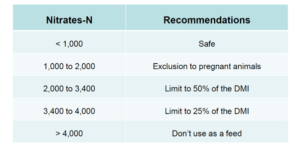
- Keep an eye on nitrate risk, especially when crops were grown under challenging conditions. In the USA (2012), similar growing conditions led to more than 25% of monitored corn silages containing nitrate levels considered unsafe to feed.
- If nitrate levels are higher than expected, follow recognised feeding guidance (see table below) and work with your nutritionist/adviser to manage inclusion rates safely.
- The ramp and shoulder areas are harder to pack and can be lower quality than the main bulk of the silo. If contamination is visible or silage is heating, avoid feeding those areas.
- Manage feedout rate and cleanliness: remove at least 20 cm from the bunker face daily to limit the growth of yeasts and moulds.
- Keep the silage face vertical, smooth and tightly packed to reduce air penetration.
- When switching from last season’s corn silage to newly made corn silage, account for starch digestibility. Starch digestibility increases over time in storage, so moving to fresh silage can change the amount of digestible starch in the ration and affect performance.
- Keep the leading edge of the plastic cover well weighted to prevent air from getting under the sheet.
- Regularly check the surface for spoilage. Problems often start when too much plastic is removed and the surface is left open too long, or when the leading edge is not weighted properly and air infiltrates beneath the sheet.
- Before feeding, blend silage taken from across the full height of the face (bucket or mixer wagon) to reduce ration and performance variation.
- Where possible, use a bunker defacer or rake to remove silage. Defacers are preferred because they don’t disturb the face of the bunker, meaning less air can ingress into the silage.
Starch Digestibility Variation
When switching from last season’s corn silage to newly made corn silage, account for starch digestibility. Starch digestibility increases over time in storage, so moving to fresh silage can change the amount of digestible starch in the ration and affect performance.
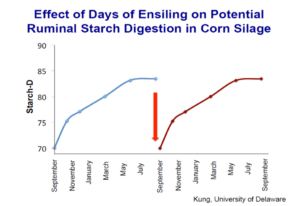
- Because fresh corn silage often has lower starch digestibility, adjust the ration to cover any shortfall in digestible starch and help avoid production losses.
- Avoid creating fracture lines that allow air into the silo.
- Remove silage evenly across the height of the face to help reduce ration variability (a common cause of performance variability).
- Leave a straight, smooth face that sheds rain rather than catching it.
- Mix the silage from across the height of the silo, reducing ration variability which can be a major cause of production variability.
- Leave a straight face, that does not catch rain.
