How Smart Silage Making Using a Forage Inoculant Can Stop Producers Losing One in Every Six Loads of Corn Harvested
With rising input costs continuing to put pressure on farm businesses, making the most of every tonne of homegrown forage is more important than ever. Maximizing the potential of every harvest by producing high-quality corn silage is one-way farmers can reduce reliance on bought-in feed, support animal performance, and enhance farm profitability.
Homegrown maize silage is potentially one of the highest-quality feeds available and the primary energy source for most dairy operations. Yet some producers see adding an inoculant at harvest as an extra step with little return. However, key risk factors often go unnoticed during silage making, leading producers to underestimate problems and the scale of losses until it’s too late.
What Are the Challenges When Making Corn Silage?
Making high quality silage from corn starts with careful harvest timing and managing variables like dry matter (DM) content, chop length and kernel processing to support efficient ensiling.
Poorly fermented maize silage can quickly become a hidden drain on farm profitability. During the ensiling process, undesirable bacteria can cause significant DM losses of 20% or greater, reducing both the quantity and the quality of feed.
The challenge doesn’t stop once the silo is opened. Silage with poor aerobic stability is highly vulnerable to heating and spoilage as yeast and molds thrive in the presence of air. Using a proven forage inoculant like MAGNIVA when making corn silage turns homegrown forage into real economic value. For a small upfront cost, producers can protect the investment in their harvest and ensure optimum quality is retained right through to the final feed.
How a Silage Inoculant Supports the Fermentation Process
While untreated silage can look fine, the presence of undesirable microbes can destroy nutrients and produce harmful mycotoxins. Using a MAGNIVA inoculant protects the quality of silage across all storage systems – improving fermentation and preserving the quality of feed.
Taking control right from the start, MAGNIVA promotes fast and efficient fermentation, limiting the activity of undesirable yeast and molds, and harmful bacteria that can cause heating and nutritional loss. The result is more efficient fermentation, with silage that stays cooler, and is more stable when the clamp is opened.
Using an Inoculant Delivers Value on the Farm
With an inoculant improving fermentation and silage stability, there are clear financial benefits for farmers from reduced waste, and more usable feed retained in the bunker after opening.
Based on a typical DM intake (DMI) of 12.9 kg per cow per day, MAGNIVA treated silage gives around two extra months of feeding from the same clamp.
Reducing Dry Matter Loss Means More Feed in the Bunker
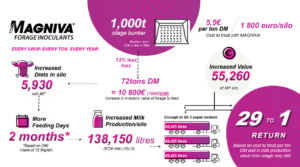
Preserving the DM of forage quickly adds up in terms of value. With MAGNIVA, DM losses can be reduced by 13%, alongside enhanced silage preservation and efficiency. This means a 1,000-tonne corn silage bunker that’s been treated, can keep an extra 72 tonnes of useable feed that would have otherwise been lost. At €150 per tonne of DM, that’s around €10,800 worth of silage saved.
When treating this same volume of silage with MAGNIVA costs around €1,800 – it’s plain to see how using an inoculant for making corn silage gives farmers a high return on investment.
Inoculants Give Farmers Long-Lasting High-Quality Feed
Maintaining silage quality after the bunker is opened is critical for animal health, milk production and overall feed efficiency. Once exposed to oxygen, silage can deteriorate quickly, increasing the risk of heating, spoilage and wasted feed.
Treating silage with a MAGNIVA inoculant helps improve aerobic stability, allowing silage to maintain its quality during feedout. By inhibiting the growth of yeast and molds that contribute to deterioration at the feed face, the inoculant helps preserve value, maintain silage quality, and reduce the risk of waste. With lost feed needing to be replaced with bought-in alternatives, every tonne of silage lost becomes a direct cost for a farm business.
Over a 24-hour period, a Total Mixed Ration (TMR) with MAGNIVA-treated silage stays up to 15oC cooler, helping maintain palatability and DMI, and ensuring silage quality is maintained day after day.
High-Quality Corn Silage Means Better Animal Performance
Well-fermented corn silage retains more nutrients, which is essential for overall animal performance.
With improved silage quality milk production is enhanced. Research shows that treating forage with MAGNIVA delivers up to 138,150 liters of Energy-Corrected Milk (ECM) per 1000t silo – that’s enough milk to fill three super tankers.
The milk production effect
Better silage fermentation with MAGNIVA can deliver up to 138,150 liters of Energy-Corrected Milk (ECM) from a single 1000t corn silage bunker.
Combined with better palatability and more stable silage at feedout, MAGNIVA produces feed with enhanced nutrition and more consistent intake, supporting optimum performance across the herd, and increasing overall feed efficiency.
MAGNIVA – Success That Adds Up
Silage losses are not inevitable – they’re manageable. In today’s volatile market, using a MAGNIVA forage inoculant with corn harvests, means producers don’t have to put their investment at risk.
When the numbers are added up, MAGNIVA delivers a return that’s hard for farmers to ignore. Reducing DM, together with increases in milk production, can mean a 29:1 return on investment for dairy farmers. Few on-farm inputs can offer such a significant return.